
Khan Meat Pointe
Khan Meat Pointe
A halal meat delivery storefront and three-role back office on Angular 21 with SSR: Stripe payments, a delivery engine, order batching for butchers, CSV/XLSX/PDF reports and a seasonal Qurbani module.
- Angular 21
- Angular SSR
- NgRx
- Angular Material
- Tailwind CSS
- TypeScript
- Google Maps
- Leaflet
- ApexCharts
- WebSockets
- Stripe
- reCAPTCHA v3
- Express
Architecture
Overview
Khan Meat Pointe sells halal meat for delivery. The platform has two parts:
- A customer storefront.
- A back office for three staff roles: Admin, Delivery Partner and Butcher.
It also has a seasonal Eid-ul-Azha (Qurbani) module that is switched on for Eid and off afterwards. The live app is built on Angular 21 with server-side rendering, using the same Angular workspace template as Wavy Cables and AA Bridal Studio. Orders are paid online through Stripe, created on the server.
The challenge
Everyday grocery delivery and Qurbani ordering are different problems:
- Regular orders need a smooth basket, delivery slots and reliable dispatch.
- Qurbani is for whole animals split into shares, and it is only offered for a few weeks a year.
Behind the store, admins, drivers and butchers each need their own tools, and delivery maps should not tie every screen to one paid map provider.
What I built
Storefront
- Halal meat categories and products, plus weekly and special offers.
- A cart that is saved in the browser and shows totals for items, price and weight.
- Checkout with shipping and billing details, a delivery-slot picker, coupon checks and reCAPTCHA v3.
- Online payment through Stripe. Checkout creates the order and opens its order page. Once the order is packed and still unpaid, the customer pays from a "Pay Now" button on that page or from a payment-reminder popup. The app asks the API to start the payment and opens the payment URL it returns. It has no card fields and does not use Stripe.js.
- Order details, reviews after an order, notifications and a contact page.
- An application form for people who want to become a delivery partner.
Back office
- Order management: assign, pack, dispatch and complete, with a payment-status filter and a "Send Payment Reminder" action for packed orders that are still unpaid.
- Order batches for butchers to prepare.
- A delivery engine: regions, zip codes, delivery slots, routes and driver assignments, with a route-preview map.
- Proof of delivery: the driver finishes an order with a photo or video from the device camera, with a front/back camera switch.
- Analytics charts (ApexCharts) and reports you can export as CSV, XLSX or PDF.
- Discounts, announcements, email subscriptions and event sales.
- Customers, team members, delivery-partner applications, contact messages, testimonials and activity logs.
Seasonal Qurbani module
Qurbani animals are their own admin resource, with type, age, price, stock and portions. They have their own storefront pages for the listing, details and booking. The module is turned on for Eid and off afterwards. In the most recent update, its storefront routes were removed while the pages and the admin side stayed in the code.
Tech & architecture
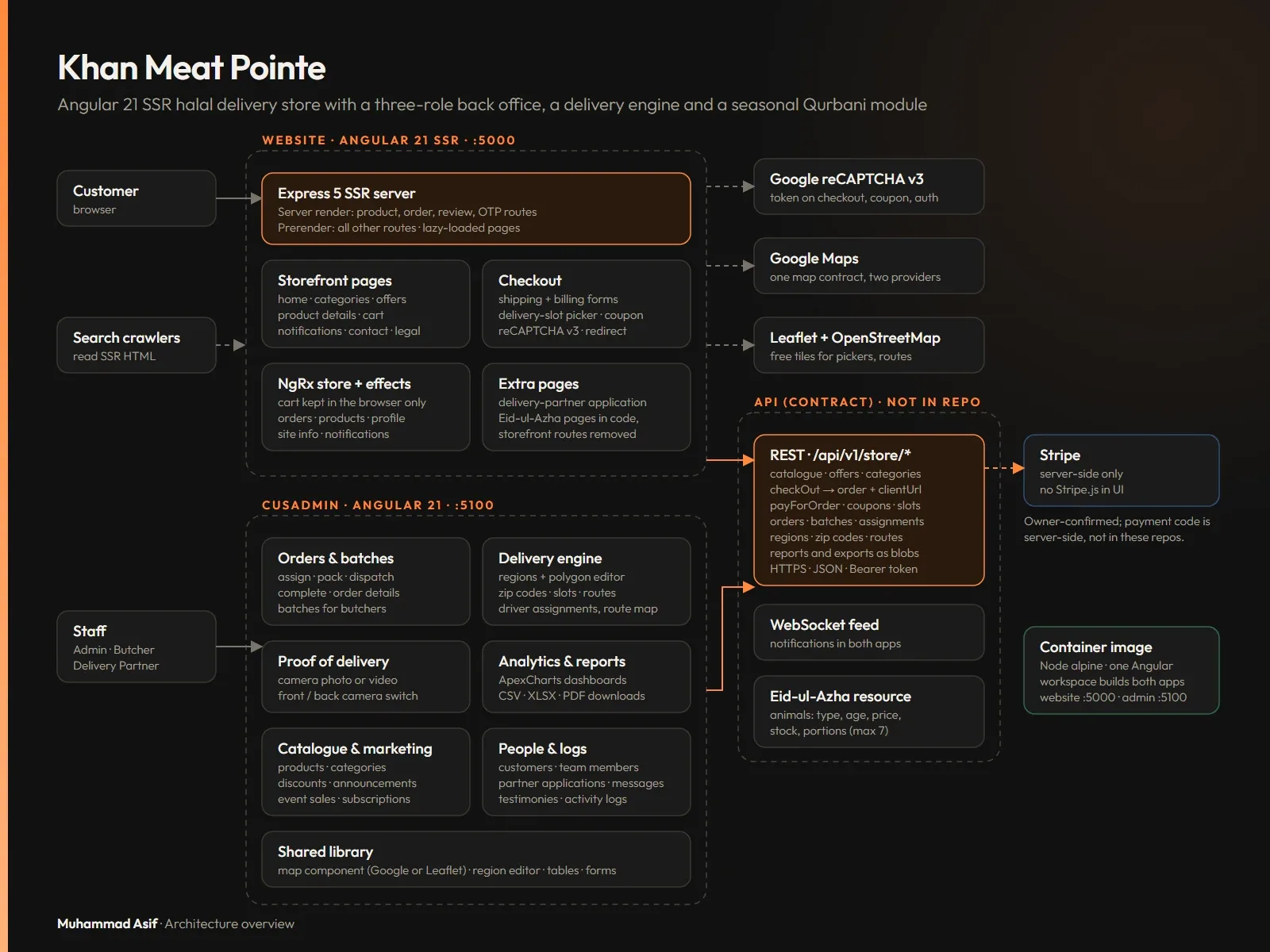
- Angular 21 with Angular SSR on an Express 5 server. Most storefront pages are lazy-loaded and prerendered. Product and order pages render on the server.
- NgRx for state across the storefront and back office.
- Angular Material and Tailwind CSS 3.4.
- Google Maps and Leaflet behind one map component, ApexCharts for analytics, and WebSockets for notifications in both apps.
- Stripe for payments, handled by the backend API. The front end only follows the payment URL it returns.
Architecture
- The Express 5 SSR server serves prerendered, lazy-loaded storefront pages, and renders product and order pages on the server.
- The NgRx cart is saved to
localStorageonly in the browser, so the server render never touches storage. Totals for items, price and weight come from the cart state. - At checkout, the customer enters shipping and billing details, picks a delivery slot from the API, applies a coupon and passes reCAPTCHA. The order is then posted to the REST API, and the app opens the order page.
- When an order is packed and unpaid, the customer taps "Pay Now" (or uses the reminder popup). The app asks the API to start the payment, the API creates it with Stripe on the server, and the browser opens the payment URL it returns.
- The back office is guarded by role (Admin, Delivery Partner and Butcher). Orders move through assign, pack, dispatch and complete.
- Regions and zip codes define where the store delivers, alongside the delivery slots. Driver assignments show a route preview with waypoints.
- Drivers record proof of delivery with the camera, and butchers work from order batches.
- Analytics and reports export to CSV, XLSX or PDF, and WebSocket notifications run in both apps.
Hard problems
One map API over two map providers
Delivery screens need maps in several modes: order pins, a location picker and a route preview with waypoints. The aim was to use Google Maps where it is worth paying for and free OpenStreetMap tiles through Leaflet elsewhere, without writing every screen twice. A shared contract defines the provider, mode, points and waypoints. A thin wrapper component passes the same inputs to either implementation.
// One map API, two providers (simplified)
@Component({
  selector: 'app-route-map',
  changeDetection: ChangeDetectionStrategy.OnPush,
  template: `
    @if (provider === 'google') { <app-gmap [mode]="mode" [points]="points" [waypoints]="waypoints" /> }
    @else { <app-leaflet [mode]="mode" [points]="points" [waypoints]="waypoints" /> }`,
})
export class RouteMapComponent {
  @Input() provider: 'google' | 'leaflet' = 'leaflet';
  @Input() mode: 'pointers' | 'picker' | 'static' = 'pointers';
  @Input() points: MapPoint[] = [];
  @Input() waypoints: LatLng[] = [];
}
A seasonal Qurbani flow next to the everyday store
Building Qurbani into the normal product and cart model would complicate everyday checkout. So animals are a separate resource with their own fields and validation: a Qurbani animal is limited to seven shares. They also have their own routes. Ending the season is a routing change: the storefront routes and the home-page Eid section come out, and the code stays for next year.
// Qurbani animals: their own resource and rules (simplified)
animalForm = this.fb.group({
  title: ['', Validators.required],
  animalType: ['', Validators.required],                          // e.g. goat, cow
  ageYears: [null, Validators.required],
  price: [null, Validators.required],
  portions: [null, [Validators.required, Validators.max(7)]],     // Qurbani share limit
  stock: [null, Validators.required],
});
// Storefront: the seasonal routes, taken out of the route table after Eid (pages stay in code)
const eidRoutes: Routes = [
  { path: 'eid-ul-azha', component: EidListPage },
  { path: 'eid-ul-azha/details/:id', component: EidDetailsPage },
  { path: 'booking/:id', component: EidBookingPage },
];
Results in numbers
- 3 Angular projects: the storefront, the back office and a shared library.
- 29 storefront routes, 26 of them lazy-loaded.
- 55 back-office routes covering 21 admin page areas.
- 3 staff roles.
- 168 components.
- 12 NgRx feature reducers (5 storefront, 7 back office) and 53 effects.
- 157 REST calls across the services.
- 3 report export formats: CSV, XLSX and PDF.
- 33 browser-only guards across 14 files, which keep maps, storage and the camera out of the server render.
Outcome
The business runs its everyday delivery store and its seasonal Qurbani sales on one platform. Admins, drivers and butchers each work in their own part of a single back office. Customers pay online through Stripe, and delivery coverage, routes, proof of delivery and reporting all live in the same system.