
AA Bridal Studio
AA Bridal Studio
A booking and studio-management platform for a bridal and beauty salon on Angular 21: an SSR site with appointment requests, a gallery and a journal, plus a role-based dashboard for the owner and artists.
- Angular 21
- Angular SSR
- NgRx
- Angular Material
- Tailwind CSS
- FullCalendar
- Google Maps Places
- reCAPTCHA v3
- WebSockets
- JSON-LD
- Express
Architecture
Overview
AA Bridal Studio is a bridal and beauty salon. Its platform covers both sides of the business:
- A public website where clients explore the studio's work and request appointments.
- A staff dashboard where the owner and the artists manage appointments, services, time slots and customers.
This version is a redesign of an earlier 2024 build, moved onto Angular 21. It uses the same Angular workspace template that Khan Meat Pointe and Wavy Cables are built on: a public site, a staff app and a shared library of form controls, pipes and table components.
The challenge
A salon website has to sell and organise at the same time:
- Brides want to see the work and understand the experience before they book.
- The studio needs requests, artists and the calendar in one place.
- The owner and the artists need different views of the same data.
- Every public page needs its own search metadata, already in the HTML.
What I built
Public website
- Seven public pages: Home, Collections (gallery), Services, The Experience, About, Journal and Booking.
- A booking form for appointment requests, with no payment. Clients pick one or more services with a head count for each, a date, a "ready by" time and an address (Google Places autocomplete).
- A journal of bridal-prep articles. The articles are part of the site itself, not a CMS.
- Customer accounts: profile, password, my appointments and appointment details, with sign-up and one-time-code verification.
- reCAPTCHA v3 on the six authentication forms. The booking form does not use it.
Staff dashboard
- An analytics home, plus management of artists, services, time slots and customers.
- An appointment lifecycle: accept, assign to an artist, complete, close. There is a list view and a FullCalendar view.
- Two roles. The studio owner manages everything, and artists see their assigned appointments.
- Live notifications over a WebSocket, shown in the dashboard sidebar and the website header.
SEO
- Each route carries its own title, description, canonical link, Open Graph and Twitter tags, and robots setting. Account and sign-in pages are
noindex. - Every page has three JSON-LD blocks: WebSite, BeautySalon and Organization.
- A build-time script generates
sitemap.xmlfrom the live services list.
Tech & architecture
- Angular 21 with Angular SSR on an Express 5 server. Public pages, including the sign-in and sign-up pages, are prerendered at build time. Only the appointment details page (
appointments/:id) and the one-time-code page (auth/otp/:route) render on the server. - NgRx for state in both apps.
- Angular Material and Tailwind CSS 3.4 for the UI, with one shared animation directive for motion.
- FullCalendar, Google Maps Places, reCAPTCHA v3 and WebSockets.
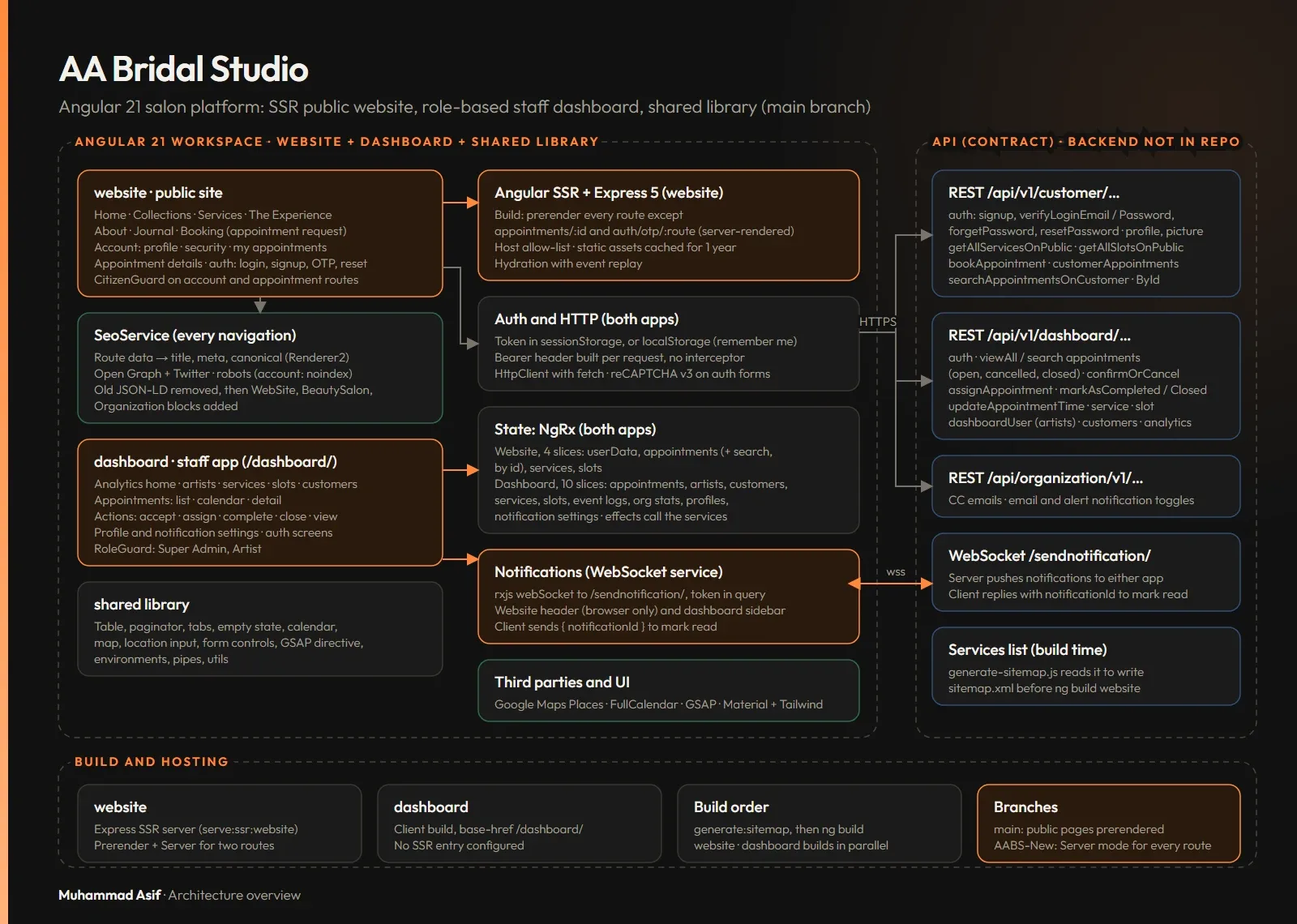
Architecture
- A visitor reaches the Express 5 SSR server, which checks the host against an allow-list and caches static assets for a year.
- Public pages, including sign-in and sign-up, are served prerendered. Only
appointments/:idandauth/otp/:routerender on the server. Hydration replays early user events. - On every navigation, an SEO service reads the route's data and writes the title, meta tags, canonical link and JSON-LD.
- A client fills in the booking form, and it posts an appointment request to the REST API.
- NgRx effects load services, time slots and the user profile, and guards protect the account area.
- The staff dashboard is a separate Angular app that uses the same shared library, with role-guarded routes.
- Each appointment moves through accept, assign, complete and close, and a WebSocket stream pushes notifications to both apps.
Hard problems
Per-route SEO on a hybrid prerendered and SSR app
Angular's Title and Meta services do not manage the canonical link or JSON-LD, and old tags can leak from one navigation to the next. So SEO is declared as data on each route, and one service turns it into tags on every navigation. It sets the canonical link through the Renderer, which works during the server render, and it removes old JSON-LD before adding new blocks. Static pages are prerendered, so the tags are already in the HTML that crawlers fetch.
// Route data -> head tags on every navigation (simplified)
applyRouteSeo(data: RouteSeo, url: string) {
  const canonical = SITE + url.split(/[?#]/)[0];
  this.title.setTitle(data.metaTitle ?? data.title + ' | ' + BRAND);
  this.meta.updateTag({ name: 'description', content: data.metaDescription ?? DEFAULT_DESC });
  this.meta.updateTag({ name: 'robots', content: data.robots ?? 'index, follow' });
  this.meta.updateTag({ property: 'og:url', content: canonical });
  this.setLink('canonical', canonical);                    // Renderer2, so it works during SSR
  this.doc.querySelectorAll('script[data-seo-jsonld]').forEach(s => s.remove());
  for (const schema of [websiteLd(), localBusinessLd(), organizationLd()]) {
    this.appendJsonLd(schema);                             // tagged with data-seo-jsonld
  }
}
One role-aware dashboard for the owner and the artists
The user's role is only known after their profile loads, and someone who opens a page they cannot use should be redirected, not shown a blank screen. So one guard checks the token, loads the profile and waits for NgRx to finish loading it. Then it compares the user's role with the roles allowed on the route. An artist who opens the analytics home is sent to their appointments.
// One guard for owner and artist roles (simplified)
canActivate(route: ActivatedRouteSnapshot, state: RouterStateSnapshot) {
  if (!this.auth.token()) return of(this.router.parseUrl('/auth/login'));
  const allowed = toList(route.data['roles']);             // array or comma-separated string
  this.store.dispatch(loadProfile());
  return this.store.select(selectProfile).pipe(
    filter(p => !p.loading), take(1),
    map(p => {
      const role = p.user?.role;
      if (!role) return this.router.parseUrl('/auth/login');
      if (role === 'Artist' && state.url === '/') return this.router.parseUrl('/appointments');
      return allowed.includes(role) ? true : this.router.parseUrl('/auth/error');
    }),
  );
}
Results in numbers
- 3 Angular projects: the public website, the staff dashboard and a shared library.
- 22 website routes and 19 dashboard routes.
- 92 components.
- 14 NgRx feature reducers (4 on the website, 10 in the dashboard) and 13 effects files.
- 61 REST calls across the services.
- 2 dashboard roles and 5 appointment action components: accept, assign, complete, close and view.
- 3 JSON-LD blocks on every page.
Outcome
The studio has one platform for marketing, appointment requests and day-to-day management, rebuilt on a current Angular stack. Clients can see the work, understand the experience and request a booking. The owner runs the appointment lifecycle from the dashboard, and each artist sees their own schedule.